
New National Landlord Database Rollout Confirmed: What ELA Members Need to Know

Updated: Sep 10
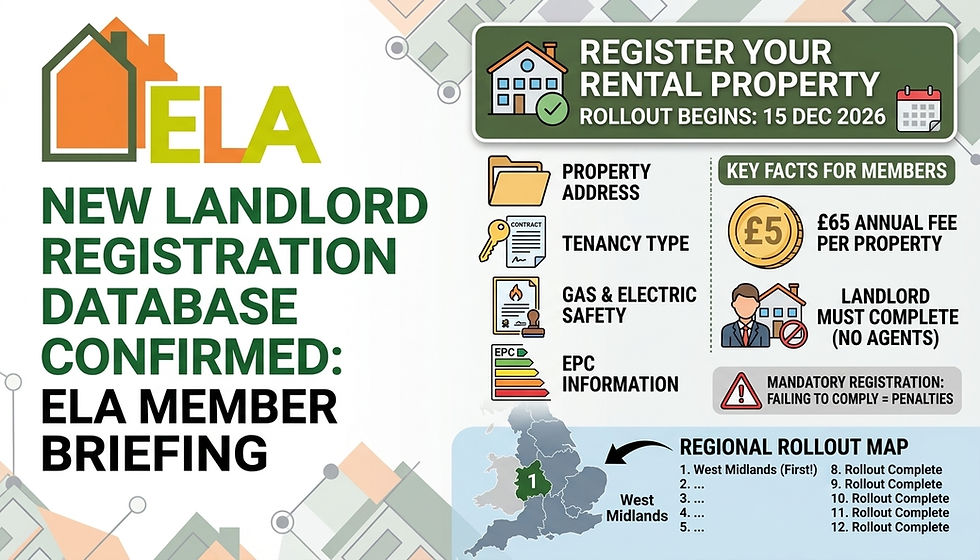
The Government has confirmed that England's new landlord registration system, known as the "Register Your Rental Property" service, will begin rolling out from 15th December 2026 as part of the next phase of the Renters' Rights Act. The system will be introduced region by region over a 12-month period, with the West Midlands becoming the first area to join the scheme. All qualifying landlords will eventually be required to register both themselves and their rental properties.
For many landlords, this represents one of the most significant regulatory changes to the private rented sector in recent years and another important compliance requirement to prepare for.

What is the Landlord Database?
The new registration service will create a national record of private landlords and rental properties in England. The Government says the database will improve transparency in the sector, help tenants make informed decisions about where they live, and provide local authorities with the information needed to identify and tackle rogue landlords more effectively.
The database forms a key part of the wider Renters' Rights reforms and is intended to provide a single source of information about private rented properties across England.
Who Will Need to Register?
Landlords of properties let under assured or regulated tenancies will be required to register.
Initially, the requirement will apply to:
Properties that are already occupied by tenants.
Properties that become occupied during the rollout period.
At this stage, vacant properties being marketed for rent will not need to be registered. However, the Government has indicated that future phases of the scheme will require landlords to register properties before they can be advertised to prospective tenants.
How Much Will It Cost?
Registration will cost £65 per property per year, with landlords required to renew their registration annually.
While the fee may appear relatively modest in isolation, it adds to the growing list of costs that landlords already face, including licensing fees, insurance, mortgage costs, compliance certification, maintenance and taxation.
What Information Will Be Required?
Although further guidance is expected, landlords are anticipated to provide information including:
Property address and ownership details.
Property type and occupancy information.
Licensing information where applicable.
Number of occupants and household details.
Rent amount and payment frequency.
Gas Safety Certificates.
Electrical safety information.
EPC information.
Landlord contact details.
Current guidance indicates that landlords will be responsible for completing the registration themselves rather than relying on a letting agent to do so on their behalf.
What Happens if You Don't Register?
Registration will be mandatory rather than voluntary. Landlords who fail to comply could face enforcement action and financial penalties. The rollout will be phased by region, and landlords will be given a registration window once the scheme opens in their area.
The key message is simple: landlords should familiarise themselves with the rollout timetable and ensure they are ready to register when required.
Changes to Rent Increase Disputes
Alongside the database announcement, the Government has also outlined plans to transfer responsibility for determining rent increase disputes from the First-tier Tribunal to HMRC's Valuation Office Agency (VOA).
The objective is to streamline the process, reduce pressure on the tribunal system and provide quicker decisions for both landlords and tenants. Until the new arrangements are introduced, tenants who wish to challenge rent increases will continue to use the First-tier Tribunal process.
Will the New Database Increase Rents?
One question many landlords and tenants will ask is whether the introduction of the landlord database will eventually lead to higher rents.
The annual registration fee of £65 per property equates to little more than £1 per week. On its own, this is unlikely to have a substantial impact on rental values.
However, the database does not exist in isolation. Landlords are already dealing with increasing compliance requirements, safety obligations, licensing schemes, taxation changes, rising maintenance costs and higher borrowing costs. The registration scheme represents another cost and administrative burden that landlords will need to absorb.
Where market conditions permit, some landlords may seek to recover additional costs through rent increases. Others may conclude that the cumulative impact of regulation and compliance costs makes continuing in the sector less attractive.
While it is impossible to predict the exact impact of the database on rents, it is reasonable to expect that many landlords will view the scheme as part of a wider trend of increasing regulation within the private rented sector.
A Challenging Time for the Private Rented Sector
The landlord database is being introduced at a time when many landlords are already facing considerable challenges.
Reports from across the sector continue to highlight concerns around rent arrears, whilst landlords seeking possession of their properties are experiencing significant delays through the court system. At the same time, the abolition of Section 21 has fundamentally changed the possession process, requiring landlords to rely on statutory grounds and, in most cases, court proceedings to recover possession.
Court delays remain a major concern. Recent analysis suggests possession cases can take many months to progress, leaving landlords exposed to ongoing rent arrears while continuing to meet mortgage payments, insurance premiums and maintenance costs.
Many landlords will therefore question whether additional regulatory requirements are being introduced at a time when the sector is already under significant pressure. While most responsible landlords support efforts to improve standards and remove rogue operators from the market, there is understandable concern that increasing compliance costs and administrative obligations could encourage more landlords to exit the sector.
If the supply of rented homes continues to decline while demand remains strong, there is a risk that rents could face further upward pressure in many areas of the country.
ELA's View
The creation of a national landlord database marks a significant change in the regulation of England's private rented sector.
There is little doubt that better data could help improve enforcement against rogue landlords and increase transparency for tenants. However, the success of the scheme will ultimately depend on whether it delivers genuine improvements without placing unnecessary burdens on responsible landlords who are already meeting their legal obligations.
At a time when landlords are dealing with court delays, rising costs, increasing regulation and continued uncertainty surrounding the implementation of the Renters' Rights Act, many will be asking whether this is the right priority for the sector.
ELA will continue to monitor developments closely and keep members informed as further guidance becomes available. We would encourage all landlords to review their compliance documentation, ensure records are up to date and begin preparing now for the introduction of the new registration requirements.
As more information emerges, ELA will provide practical guidance and support to help members navigate the changes ahead.


Comments